

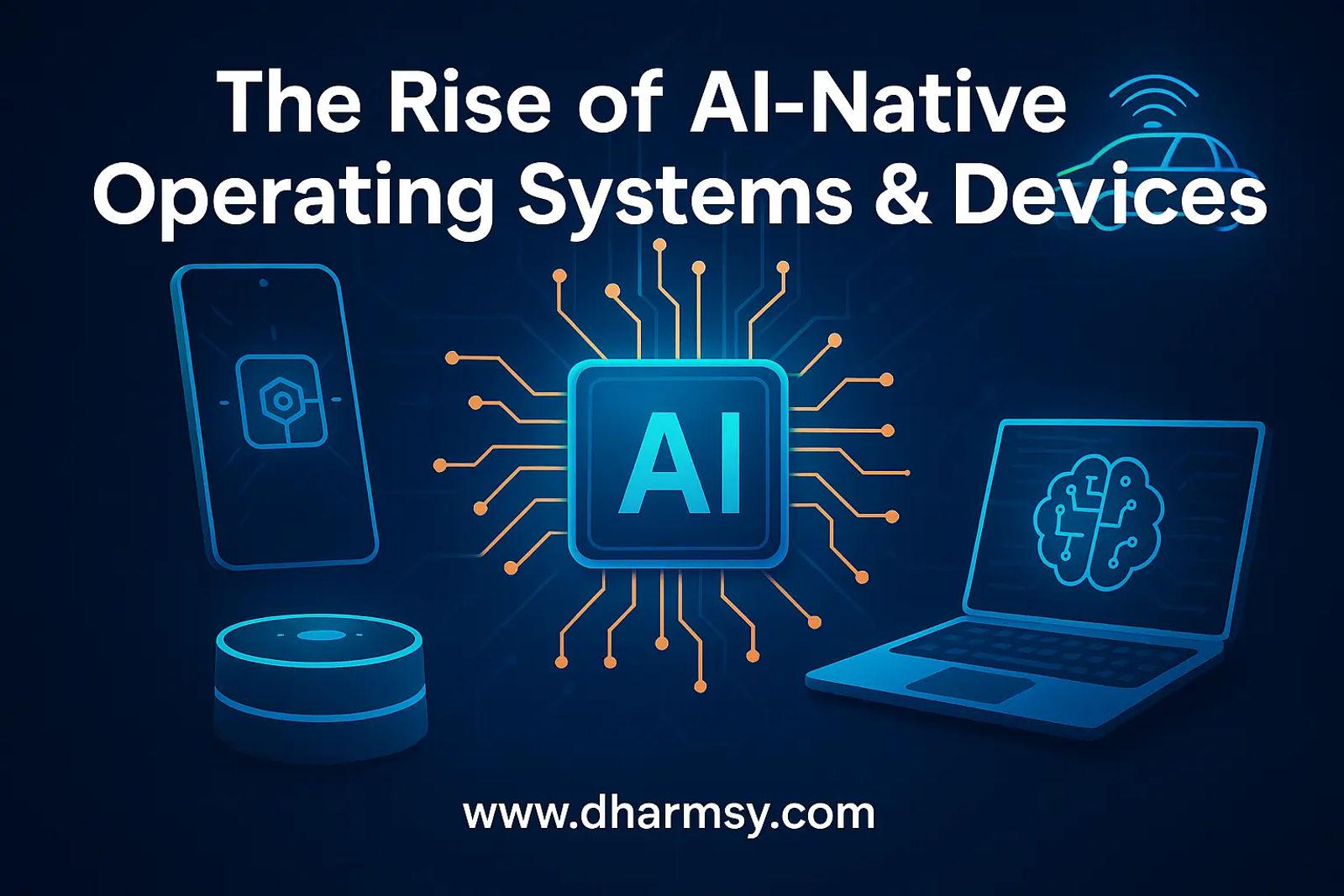
For decades, operating systems (OS) have served as the bridge between humans and machines. From the days of DOS command lines to the sleek UI of iOS and Android, the OS has evolved — but its core philosophy remained the same: manage hardware, run applications, and provide a user interface.
Now, as artificial intelligence (AI) moves from cloud servers to edge devices, a new era is beginning — the AI-native operating system. These next-generation OSs are not just “AI-powered.” They are AI-first, designed from the ground up to learn, adapt, and anticipate human needs.
Tech giants like Google, Apple, Microsoft, and emerging startups are racing to build this new foundation — where every interaction is enhanced by AI’s context awareness, personalization, and autonomy. The implications span everything: from smartphones and wearables to IoT ecosystems, smart homes, and even in-vehicle systems.
This article dives deep into why AI-native OSs are rising, how they differ from today’s platforms, and what this means for mobile, IoT, and transportation systems in 2026 and beyond.
1. From AI-Enabled to AI-Native: What’s the Difference?
Let’s start by defining a critical distinction.
AI-enabled systems — like Android or iOS today — use AI as an added layer. Examples include:
- Google Assistant or Siri responding to queries.
- Adaptive battery optimization.
- Voice-to-text or face recognition in camera apps.
But these are isolated functions — AI acts as a “plugin,” not as the OS’s foundation.
AI-native operating systems, however, embed intelligence at the kernel and process level. They’re architected to:
- Continuously learn from the user’s habits, environment, and context.
- Optimize system resources dynamically using predictive modeling.
- Adjust UI/UX in real time based on behavioral data and emotional cues.
- Integrate cross-device intelligence through federated learning.
Imagine your phone, car, and smartwatch not just syncing — but co-thinking. Your device knows when you’re driving, automatically silences notifications, and prepares a summary of your upcoming meetings when you stop.
That’s AI-native behavior — the OS doesn’t just execute commands, it understands context and intention.
2. The Technological Foundation Behind AI-Native OS
Building an AI-native OS requires three core pillars of advancement:
a. On-Device Machine Learning (Edge AI)
Instead of sending data to the cloud for analysis, AI models now run locally on devices.
Thanks to chips like:
- Apple’s Neural Engine,
- Qualcomm’s Hexagon DSP,
- Google’s Tensor Processing Unit (TPU),
AI processing can happen directly on your phone, watch, or car dashboard — offering:
- Faster inference.
- Lower latency.
- Enhanced privacy (data stays on the device).
This decentralization of AI computation is essential for real-time decision-making.
b. Contextual Awareness Frameworks
AI-native OSs integrate contextual sensors that continuously capture user behavior and environmental data — from camera input and motion sensors to location, tone of voice, and even biometrics.
They combine this data into a context vector that the OS uses to make autonomous decisions.
For example:
- If the OS detects you’re walking and listening to music, it reduces notification frequency.
- When you’re home, it syncs with your smart lights and thermostat to create a personalized ambiance.
These micro-adjustments build a sense of fluid digital companionship, far beyond rigid “if-this-then-that” logic.
c. Neural Interfaces and Adaptive UI/UX
AI-native systems learn how you interact — touch pressure, gaze patterns, reaction times — and redesign interfaces on the fly.
We’ll see:
- UI personalization: Font size, colors, and layouts adapt automatically for mood and environment.
- Gesture-based intelligence: Systems that know your habits (e.g., double-tap means quick reply).
- Multimodal input fusion: Speech, vision, and touch interpreted simultaneously for natural interaction.
Essentially, the UI disappears, replaced by an invisible layer of intelligent responsiveness.
3. Industry Leaders Driving the AI-Native OS Revolution
Google’s Android “Gemini OS” (Expected 2026-2027)
Rumors suggest Google is working on a fully AI-integrated Android fork, powered by Gemini LLMs, enabling:
- Predictive app launching.
- Real-time multimodal assistants.
- Federated cross-device learning.
Imagine an Android that remembers every context — your driving routine, sleeping habits, and productivity schedule — to adjust performance and recommendations automatically.
Apple’s Evolution Toward an AI-Core iOS
Apple’s approach has always been privacy-driven. Its Neural Engine and on-device models already manage:
- Voice recognition (Siri 2.0).
- Camera scene optimization.
- Predictive keyboard and health tracking.
By 2026, analysts expect iOS to transition into a neural-centric architecture, where the OS proactively personalizes your digital environment without cloud dependency.
Apple may rebrand Siri as an “OS-level intelligence layer,” not a standalone assistant.
Microsoft’s AI-Core Windows & Copilot OS
Microsoft’s Copilot ecosystem aims to make Windows an AI hub, where:
- Every file, app, and workflow is indexed and semantically linked.
- The OS itself acts as a conversation partner (“Ask Windows to configure your workspace”).
- AI automates configurations, updates, and system maintenance.
This is a hybrid AI-native model — balancing edge and cloud intelligence for enterprise ecosystems.
Emerging Startups & OS Innovators
Smaller players are entering the game too:
- Nothing OS (AI) is building voice-centric OS layers for minimalist phones.
- Rabbit R1 demonstrated the concept of AI-based task delegation, where the OS uses a “Large Action Model” to execute tasks across apps.
- Humane’s Ai Pin uses an AI-driven micro-OS that eliminates screens entirely, relying on projection and voice.
These pioneers are redefining how users “interface” with technology — not through icons or taps, but through contextual intelligence.
4. The Impact on Mobile Devices
a. The Smartphone as an Intelligent Companion
AI-native smartphones will:
- Manage your digital life like a personal chief of staff.
- Anticipate communication needs.
- Schedule and summarize meetings automatically.
- Curate content dynamically (articles, playlists, health reminders).
Rather than juggling apps, you’ll converse with your device.
This shift also marks the death of the “app store model.” Instead of launching apps manually, users will make requests (“Book a table for two at an Italian restaurant near my office”) — and the OS will orchestrate actions across APIs autonomously.
b. Security and Personalization at Scale
AI-native systems combine:
- Biometric security (face, fingerprint, voice, gait).
- Adaptive privacy (data shared only when necessary).
- End-to-end encryption with federated models.
Your phone’s AI becomes an independent decision-maker, mediating between you and your data ecosystem.
5. Impact on IoT and Smart Environments
The rise of AI-native OSs will blur boundaries between devices.
Your IoT ecosystem — appliances, vehicles, wearables — will operate as a unified cognitive network.
For example:
- Your smartwatch detects elevated stress → alerts your car OS → which plays calming music when you enter.
- Your refrigerator predicts low groceries → communicates with your e-commerce AI agent → orders food automatically.
This isn’t automation through hard-coded logic — it’s emergent intelligence through continuous learning.
As 2026 approaches, manufacturers like Samsung, LG, and Bosch are investing in AI-unified firmware to connect devices seamlessly across ecosystems.
6. In-Vehicle Systems: The Rise of the “Cognitive Car”
The automotive sector is perhaps the most exciting testing ground for AI-native operating systems.
Companies like Tesla, Rivian, and BYD are moving beyond autopilot — creating vehicles that understand driver intent and emotional state.
AI-native in-vehicle OSs will:
- Adjust cabin lighting, music, and temperature based on biometric cues.
- Predict routes dynamically using live context (mood, schedule, preferences).
- Integrate with home and mobile systems for seamless continuity.
Cars evolve from “machines you drive” to companions that drive with you.
7. Design Philosophy: UX Without Interface
An AI-native OS prioritizes user experience without friction.
Instead of fixed layouts, the interface is fluid, invisible, and context-adaptive.
Future devices will:
- Display content when needed and hide when not.
- Speak and listen naturally through voice or gesture.
- Present relevant tools proactively (“Would you like me to summarize this document?”).
Designers will focus less on UI elements and more on intent mapping — understanding why users interact, not just how.
8. The Ethical and Regulatory Landscape
AI-native devices bring immense promise — but also profound ethical implications.
a. Privacy:
Constant contextual monitoring raises concerns about surveillance. Regulations like the EU AI Act and India’s DPDP Bill demand transparency and data minimization.
b. Bias and Fairness:
If AI decides what information you see, it can shape perceptions and behaviors. Ensuring neutrality in AI-driven experiences becomes vital.
c. Control:
Who owns the decisions — you or your OS? Users must retain override control over autonomous behaviors.
9. The Business Impact: Ecosystem Wars Ahead
AI-native OSs will redefine competition among tech giants:
- Hardware and software become inseparable.
- Data ecosystems — not devices — drive revenue.
- The most successful companies will be those offering privacy-preserving personalization.
This means we may soon see AI-native subscription ecosystems — where your OS acts as your digital concierge across every connected environment.
10. Conclusion: The Dawn of Ambient Intelligence
In 2026 and beyond, the OS is no longer just software. It’s a living intelligence layer — the heartbeat of your personal ecosystem.
AI-native operating systems and devices represent the next evolution of human-computer symbiosis.
They’ll make technology fade into the background, creating a world where automation feels human and interaction feels effortless.
From smartphones to vehicles, from homes to factories — every system will eventually converge into an AI-native continuum.
The challenge for creators, however, lies in trust, transparency, and balance — building systems that serve humanity’s intent, not dictate it.
Because the real future of AI isn’t just about smarter machines —
It’s about more intuitive, empathetic, and context-aware companions that understand us better than ever before.